Children develop from 0 to 5 through relationship, not routines. Warm, predictable connection shapes brain development, emotional growth and confidence far more than milestones or activities ever could.
By Tiny Hands Big Adventures – December 2025
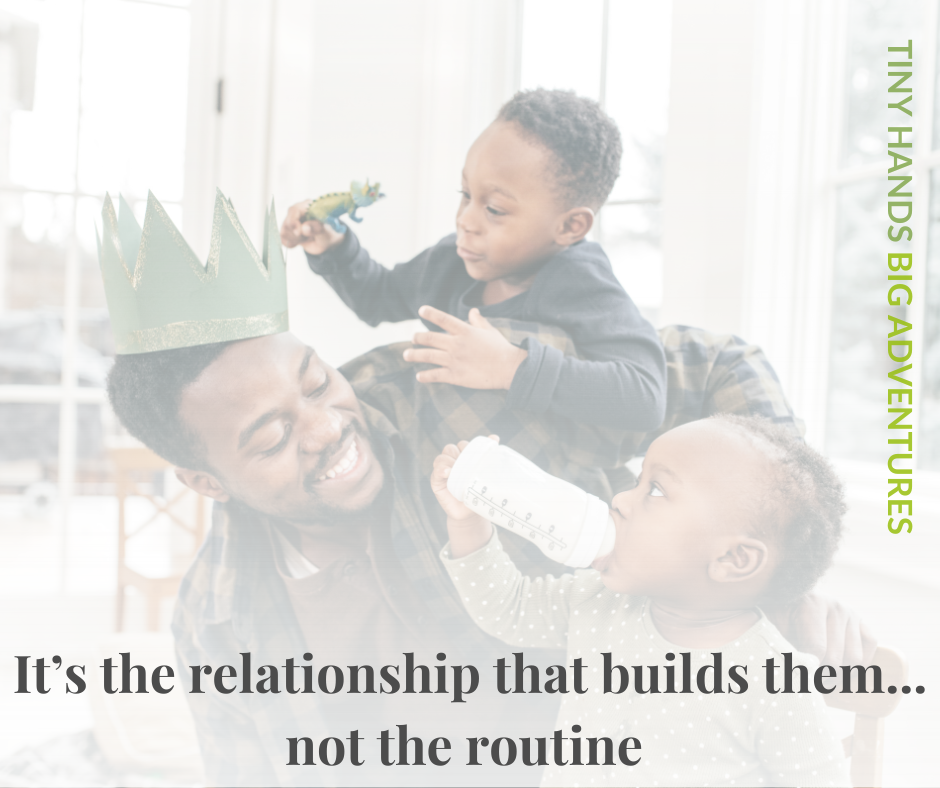
The first five years are often spoken about in measurements, first words, first steps, first numbers, first friendships. But development does not happen in neat lines or tidy jumps. It moves like the early years themselves, in waves and spirals and plateaus and bursts.
What actually drives development from 0 to 5 is not the timetable…
It’s the relationship.
Children grow most steadily when they feel safe, understood and held by adults who return to them again and again. Parents and caregivers become the environment their child develops within, not by doing more, but by being consistently present.
It is not about societal demands or Pinterest perfect activities… What matters is that the child knows there is an adult they can come back to whenever they need to steady themselves.
In the earliest months, growth is almost entirely relational. Babies develop through the way they are held, fed, soothed and responded to.
A baby’s brain is not waiting for stimulation… it is waiting for safety.
Warm arms, predictable touch, a familiar voice and the meeting of basic needs create the first pathways for trust and regulation and connection. These early interactions become the foundation for everything that follows.
Long before babies learn skills, they learn people… and that recognition becomes their first developmental milestone.
As mobility increases, so does emotional intensity… Toddlers do not develop in a vacuum, they develop while staying connected to the adults they rely on.
Climbing, pointing, babbling, exploring, refusing, laughing, melting down, none of these things are separate. They are all part of one broad developmental picture. They are figuring out what they can do and how the world responds when they do it.
When a toddler looks back at a parent for reassurance, it is not a sign of insecurity. It is the developmental dance between autonomy and connection… This gentle back and forth, stepping away then returning, builds the groundwork for later confidence.
By three, four and five, children begin to show a stronger sense of self… but relationship remains the anchor.
Their language grows richer because adults have been speaking with them, not at them.
Their play becomes deeper because someone once sat alongside them on the floor.
Their problem solving grows because adults helped them regulate their frustration in their earlier years.
Their friendships develop because they have experienced kindness, boundaries and repair at home.
Preschoolers do not suddenly become independent… They become rooted, held by a relationship that has been shaping them since birth.
Why connection before correction matters
Across the 0 to 5 journey, the child’s brain develops from the bottom upward. The parts responsible for big feelings and sensory experience come online long before the parts responsible for reasoning or foresight.
This means young children behave from their nervous system first, not from logic.
When adults offer connection before correction, they are not being indulgent, they are supporting brain development.
A calm voice, a gentle touch, sitting close, all of these things offer access to regulation the child cannot reach alone. Learning happens after safety, not before it.
In the early years, children lead with their feelings and their senses. The part of the brain that helps them reason or pause or think things through develops much more slowly, which is why their reactions can feel so big.
Children learn best from adults who feel emotionally reachable
Responsive relationships don’t require perfection. They ask for moments of warmth, moments of predictability, moments where the adult can return after things feel off, moments of attunement, moments of presence.
Presence matters far more than performance.
A child learns how to regulate by borrowing their parents nervous system. This remains true from newborn to preschooler and beyond.
Why the relationship is the developmental curriculum
From 0 to 5, the parent – child relationship supports,..
language development through shared communication,
emotional development through co regulation,
physical development through safe exploration,
social development through modelling and repair,
cognitive development through interaction and curiosity.
When parents worry about stimulation or activities or learning experiences, they can miss the quiet truth… a child gains more from five minutes of real connection than from an hour of overwhelmed activity.
Development thrives in relational richness, not constant doing.
The everyday moments, narrating what you are doing, making eye contact, offering comfort, answering questions, playing briefly, stepping outdoors together, laughing at something tiny, these moments are the building blocks of early childhood.
Children do not need expert led experiences… they need the adults they trust.
A parents steady hands support sensory regulation, predictable presence shapes emotional resilience and playful curiosity builds confidence.
The adult is the environment…
The relationship is the curriculum…
And development unfolds within it.
Development is not linear… and that is healthy
Across the early years, children often:
Regress before they progress..,
Pause one area while another grows…
Leap forward unexpectedly…
Need more connection during growth spurts…
Show behaviour changes during big developmental shifts.
Parents often worry when development feels uneven, but unevenness is natural. It is a sign of growth. Children develop gradually and rhythmically, with bursts and rests.
These developmental ebbs and flows are natural
Further Reading
Attachment and early relationships
Anna Freud Centre, What is attachment
https://www.annafreud.org/resources/under-fives-wellbeing/what-is-attachment/
Anna Freud Centre, Early years resources
https://www.annafreud.org/resources/under-fives-wellbeing/
Development and early learning
NSPCC Learning, Child development 0 to 5
https://learning.nspcc.org.uk/child-development
NHS, Your child’s development 0 to 5
https://www.nhs.uk/conditions/baby/babys-development/