
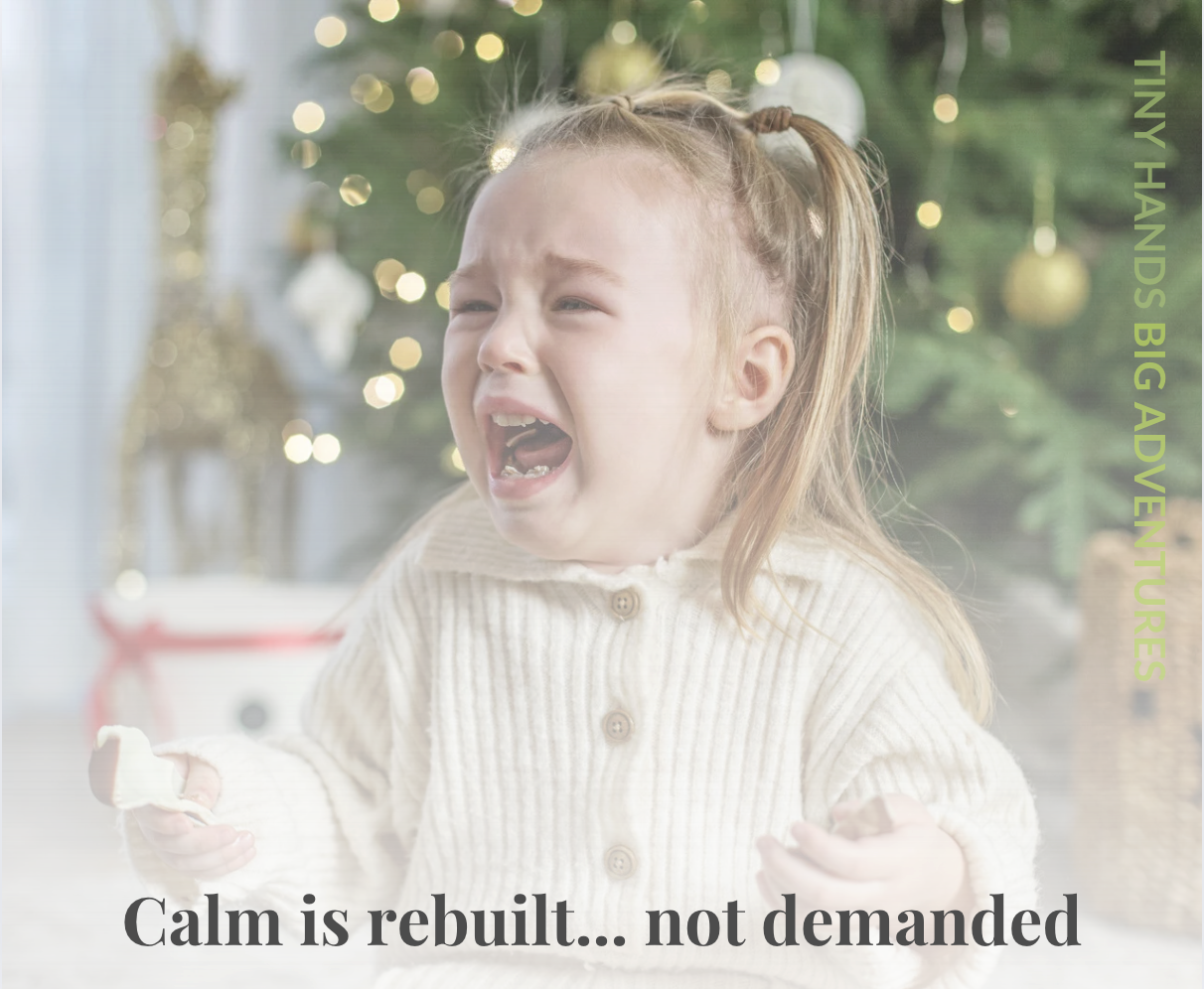
Busy periods can be full of warmth, love and connection. They can also be loud, unpredictable and emotionally intense… especially for young children.
By Tiny Hands Big Adventures – December 2025
After holidays, celebrations or changes in routine, parents often notice a shift. Big emotions surface. Sleep feels unsettled. Behaviour feels more reactive. Children who usually cope well may seem dysregulated, clingy or quick to overwhelm.
This can feel worrying, particularly when everyone is trying to “get back to normal” and can sometimes be a sign that their nervous systems are recalibrating.
Young children can rely heavily on predictability and co-regulation to feel safe. During busy periods, many of the things that support their emotional regulation change all at once….
Routines may be disrupted. Bedtimes may shift. There may be unfamiliar places, new faces, lots of social interaction and heightened excitement.
Even positive experiences require regulation.
Excitement, anticipation and fun all activate the nervous system. When stimulation is prolonged, children often need time… and support, to settle back into balance. What we often see after busy periods is not misbehaviour, but release… after all emotional regulation doesn’t switch back on overnight and children don’t move smoothly between emotional states.
Their nervous systems learn through experience, and transitions take time…
After periods of heightened stimulation, children may show increased emotional reactivity, tearfulness, frustration or a stronger need for closeness… Some may struggle with sleep or show changes in behaviour that feel unexpected. These responses are not defiance or habits forming, they are signals that the child’s system is still processing what it’s been through.
Children don’t need correction in these moments. They need containment… after all co-regulation comes before self-regulation…
Children learn how to regulate their emotions by borrowing the calm of the adults around them. This may mean that after busy or emotionally loaded periods, children often need more connection, not less. They may seek reassurance, familiarity or closeness because those are the experiences that help their nervous system feel safe again.
Their calm returns through predictable presence, repeated reassurance, familiar rhythms and emotionally available adults.
Their self-regulation develops over time, but only after many experiences of being regulated with someone else… Small shifts that support calm
Finding their calm again doesn’t require a strict reset or rigid routines. It often comes through small, consistent adjustments that gently signal safety to the nervous system… returning to familiar rhythms can help. Regular mealtimes, bedtime cues and everyday routines act like anchors. They don’t need to be perfect and regimental, just predictable enough to feel familiar.
Reducing sensory load can also support regulation. Quieter moments, softer lighting, fewer demands and less rushing help children’s bodies settle. Connection matters deeply here also… Short moments of shared attention, sitting together, reading, chatting, or playing briefly on the floor all help children feel emotionally held.
Gently naming what’s happening can also support regulation. Simple acknowledgements like “It’s been a busy time” or “Your body might still be catching up” help children make sense of their feelings without pressure to change them.
Behaviour is communication during transitions and after periods of excitement or disruption, behaviour often becomes the language children use to express overwhelm.
This might look like resistance, emotional outbursts, or difficulty cooperating. It can be tempting to respond with firmer control when behaviour escalates, but regulation is restored more quickly when children feel understood rather than managed. Staying alongside children during these moments… rather than trying to fix or stop the feeling, teaches them that emotions are safe to have.
Once the nervous system settles, behaviour usually follows.
We can’t forget Parents either because parents are not immune to post-busy-time dysregulation either.
Tiredness, emotional load, social pressure and the return to everyday responsibilities all affect adult nervous systems and children are deeply sensitive to this. Supporting your own regulation is not selfish. It is protective… Small acts of care… slowing down, lowering expectations, finding moments of rest, asking for help all support you to show up more calmly for your child.
It’s also helpful to remember that for little ones there is no rush to “get back to normal”… There is often an unspoken pressure to reset quickly after busy periods… But children don’t need to bounce back on a timeline… they need time to integrate experiences, return to rhythm and reconnect emotionally. Their calm doesn’t come from enforcing order… it comes from feeling safe again.
Calm is rebuilt, not demanded… Emotional regulation after busy times isn’t about controlling behaviour or eliminating feelings… It’s about rebuilding safety.
Through consistency.
Through presence.
Through understanding.
With time, children’s nervous systems usually settles well. Sleep evens out. Emotions soften. Behaviour stabilises… Not because they were pushed to cope, but because they were supported to do so.
Further reading
Anna Freud Centre – Under fives wellbeing
https://www.annafreud.org/resources/under-fives-wellbeing/
NHS – Talking to your child about feelings
https://www.nhs.uk/mental-health/children-and-young-adults/advice-for-parents/talk-to-children-about-feelings/ nhs.uk
ZERO TO THREE – Your calm is their calm: co-regulation strategies
https://www.zerotothree.org/resource/your-calm-is-their-calm-co-regulation-strategies-for-infants-and-toddlers/ ZERO TO THREE
UNICEF – Parenting for child development
https://www.unicef.org/parenting/child-development
Beacon House – Resources (window of tolerance / regulation support)
https://beaconhouse.org.uk/resources/
Young Minds – Supporting your child’s mental health
https://www.youngminds.org.uk/parent/parents-a-z-mental-health-guide/