
By Tiny Hands Big Adventures – January 2026
Somatics is a word that’s appearing more often in conversations about wellbeing, trauma, regulation and healing. It can sound technical or a little abstract at first, especially if you’re already carrying a lot as a parent.
But at its heart, somatics is very simple… Somatics is about the body.
Not the body as something to fix or control, but the body as something that feels, senses, responds and remembers. After all, before we ever had language, logic or understanding, we had bodies. And for babies and young children, the body is still the first and most important way that they experience the world.
Understanding somatics in simple terms
The word somatic comes from the Greek word soma, meaning the living body.
Somatic approaches recognise that our experiences live not only in our thoughts, but in our nervous system, muscles, breath and sensations. This includes experiences that were loving and supportive, as well as those that felt overwhelming, frightening or rushed. When something feels too much, the body automatically moves into protection mode, we often talk about this as ‘ fight or flight ‘ .
Our heart rate changes. Breathing alters. Muscles tense. Stress hormones are released. This is the nervous system doing its job.
The challenge comes when the body doesn’t get the chance to settle afterwards… even when life moves on, the body can remain on high alert. This can show up as tension, anxiety, restlessness, emotional overwhelm or a constant feeling of being “on edge”.
This is as true for babies and children as it is for adults.
Babies, children and the nervous system
Babies are entirely somatic beings. They experience everything through their bodies first… Hunger, comfort, fear, safety and connection are all felt physically before they are ever understood cognitively.
As baby’s nervous system is still developing they rely heavily on the adults around them to help regulate it. This process is known as co-regulation, which simply means babies borrow calm from a calm adult.
This happens through everyday, ordinary moments:
being held
skin to skin contact
gentle, responsive touch
familiar voices
steady breathing
being met consistently and predictably
When a baby cries, their body is communicating a need… It’s not misbehaviour, it’s not manipulation… It is communication.
Somatic support for babies is about responding to that communication with presence and sensitivity, rather than urgency or pressure to stop the crying. Slowing the body. Softening the touch and allowing the nervous system to settle naturally.
As babies grow into toddlers and young children, they are still learning how to manage big feelings in their bodies. This is why emotions often show up physically rather than verbally.
Clinging. Pushing away. Running. Freezing. Meltdowns… These are all nervous system responses, not conscious choices.
A somatic lens helps us look beneath behaviour and ask a different question;
Not “How do I stop this?”
But “What does their body need right now?”
Very often, the answer is not explanation or correction… but connection.
Why somatics matters so much in early years
When a child’s body feels safe, their brain is free to learn, play, explore and connect.
When a child’s body feels under threat, learning switches off. Survival takes over.
This is why regulation always comes before reasoning, especially in the early years.
Somatic approaches are grounded in the understanding that stress and overwhelm live in the body, not just the mind. Researchers such as Peter Levine have shown that unresolved stress responses can remain stored in the body long after an experience has passed.
For babies and children, stress might come from things that are common and often unavoidable such as:
separation
medical procedures
birth experiences
sensory overload
transitions
being rushed
not yet having the words to explain how they feel
Somatic support helps children move through these experiences with their nervous system supported… rather than carrying them forward as ongoing tension.
What somatic support actually means in practice
Somatic support is about helping the body feel safe again… Rather than working only through talking, explaining or reasoning, somatic approaches focus on the body’s signals. Breathing, muscle tension, movement, touch, closeness and pace.
It recognises that stress and overwhelm show up in the body first. This is especially true for babies and children, who don’t yet have the words to explain what they’re experiencing.
Somatic support meets the body where it is and gently helps it settle.
For babies, this might look like being held, soothed, rocked or kept close.
For children, it might look like reassurance, movement, slowing things down or staying physically nearby during big feelings.
For parents, it might look like noticing your own breath, shoulders or pace and allowing them to soften.
Nothing is forced. Nothing is rushed… The body leads.
Somatics, touch and early connection
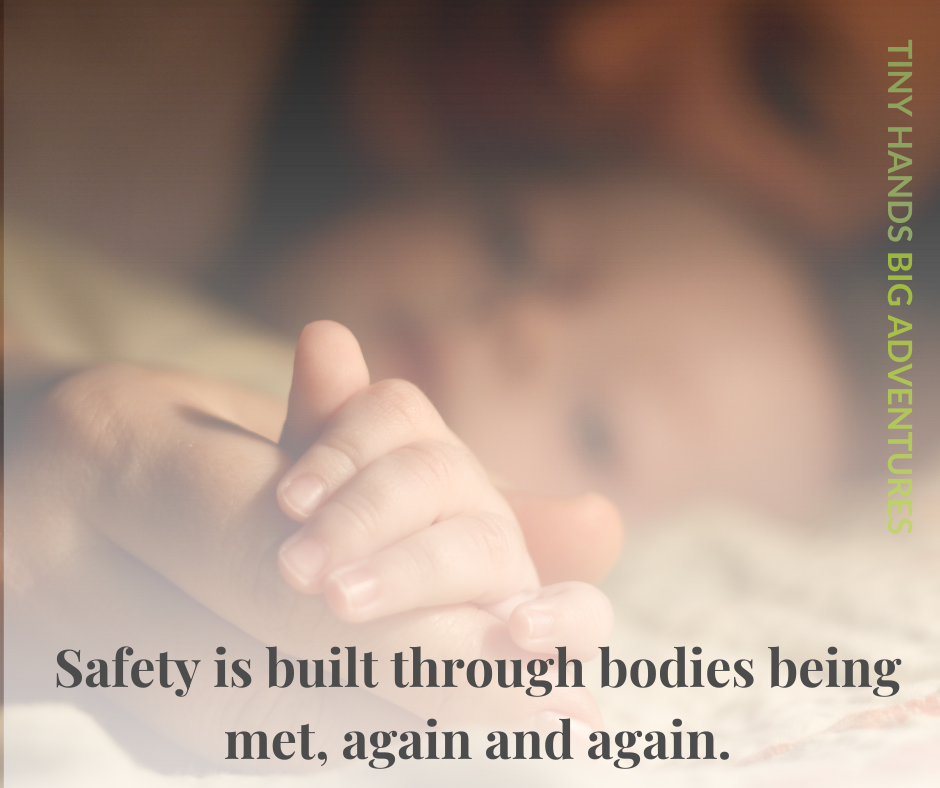
Touch is one of the earliest and most powerful ways the nervous system learns about safety.
Slow, responsive, consent-led touch supports regulation by influencing breathing, heart rate and stress hormones. This is why practices such as skin to skin contact, gentle holding and baby massage are so supportive in the early months.
Not because they make babies “behave” or “settle better”… but because they help babies feel held, safe and understood in their bodies.
For parents, this kind of touch can be deeply regulating too… When bodies settle together, breathing slows together. There is no performance and no pressure to get it right.
Just presence.
This is particularly important in the fourth trimester, when parents are often depleted, emotional and adjusting to enormous change… Supporting the parent’s nervous system supports the baby’s nervous system too.
What somatic support looks like in everyday life
Somatic support does not need to be complicated or time consuming;
For babies, it may look like slowing down, holding them close and breathing steadily, or watching their cues and responding.
For toddlers and children, it may look like staying physically close during big emotions, offering movement when feelings are intense, or allowing time and space for the body to calm before expecting words.
For parents, it often begins with noticing your own body. Your breath. Your tension. Your pace.
It’s important to remember that babies and children are not meant to regulate alone… and neither are parents.
So if things feel messy, intense or overwhelming at times, it doesn’t mean something is wrong. It means nervous systems are responding to the world around them.
Somatic support is not about fixing or controlling, it is about creating enough safety for bodies to regulate again.
Slowly… Gently… In relationship.
This is why slowing down matters…
Why touch matters…
Why presence matters… Because regulation is learned in the body first… Always
Further Reading
5 Ways to Nurture Somatic Awareness and Self-Regulation in Children – The Embody Lab
A clear, accessible article exploring what somatic awareness looks like for children and how caregivers can support regulation through the body.
• Handspring Health – Co-Regulation: Tools to Support Kids’ Emotions (includes “somatic and sensory levels” for infants/toddlers)
https://www.handspringhealth.com/post/co-regulation-guide
Blossom & Berry – The Science of Infant Massage
Explores how touch, breath and nervous system responses support babies’ regulation and early connection. This page references somatic-based practices in the context of infant development and nurturing care.