
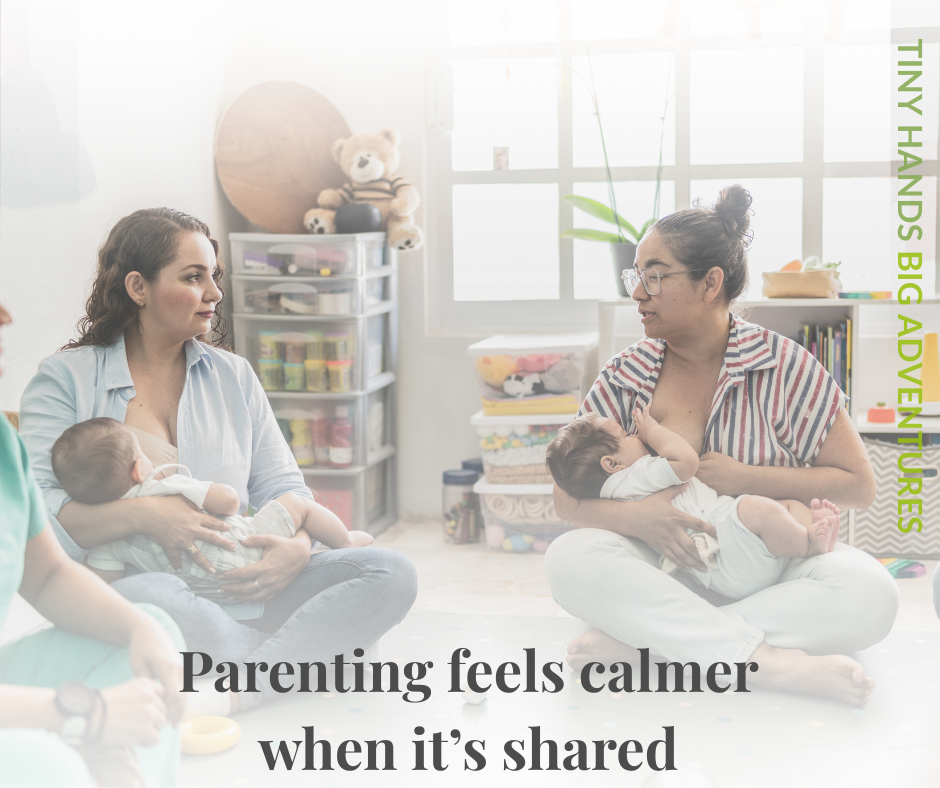
And why the feel of a space is just as important as the activity itself.
By Tiny Hands Big Adventures – February 2026
When we talk about early years, the focus usually lands on the baby or child. Their development. Their behaviour. Their sleep. Their emotions. And of course that matters.
But behind all of that is you. The one holding the day together.
Your wellbeing is not separate from your child’s world. It quietly shapes it. Parenting small children is not just practical. It is emotional work. You are constantly reading cues, responding to needs, soothing big feelings and trying again after long nights. Even on the good days, it can take more out of you than you expected.
In the early years, children regulate through us. When we feel calmer, their bodies often follow. But you were never meant to be calm all the time. No one can be. You need somewhere to land as well.
Modern parenting can feel oddly lonely. Even with social media, sometimes especially because of it. It can look as though everyone else is managing better or enjoying every minute. Add in broken sleep and long stretches without adult conversation and it is easy for self doubt to creep in.
You can love your child completely and still feel overwhelmed. Those two things can exist at the same time.
When we feel unsupported, stress shows up in the body. Shoulders tighten. Breathing shortens. Patience feels thinner. Connection helps soften that. A real conversation. A shared look across the room that says “same here”. Someone listening without trying to fix you.
That is why parent and baby groups, and children’s groups, matter for more than just the activity laid out on the floor.
There are many bright and busy groups offering wonderful opportunities for children. They can be fantastic. This is not about saying those spaces are wrong. It is about recognising that gentler atmospheres matters too.
It matters whether you can walk in exactly as you are.
Whether your baby can cry and no one looks uncomfortable.
Whether your toddler can wobble and no one judges.
Whether you can admit you are tired without feeling awkward.
It is adult conversation while your little one explores. It is reassurance without pressure. It is not having to pretend everything is fine.
When a parent feels even slightly more supported, something shifts. There is often a little more patience. A bit more capacity to reconnect after a tricky moment. And that shift spreads. To your baby. To your home. To the overall feel of family life.
Sometimes we do not need louder or busier. Sometimes we need slower. Gentler. More flexible. Space for feeding. Space for stepping outside. Space for questions and even tears.
When a space feels safe, bodies settle. And when bodies settle, it becomes easier to enjoy small moments instead of simply getting through the day.
Babies and children benefit when their parents feel calmer. Not because you suddenly become endlessly patient, but because there is more calm available in the room. More repair after a wobble. More connection after a long morning. Parental wellbeing supports child development in ways that are often invisible but very real.
And this matters too. Your wellbeing would still matter even if we did not mention children at all.
You are not meant to carry this on your own. Most of us need support at some point. Most of us feel worn out. And most of us miss having proper adult conversation. That doesn’t say anything about your love for your child. It just says you’re human.
You matter because you’re a whole person, with needs and thoughts and limits, not just someone responsible for a small one.
Parenting changes when it’s shared with other people. When there’s space to talk. When you don’t feel like you have to hold everything in.
That’s where community makes a difference. 🤍
Further Reading
Research from Glasgow Caledonian University explores how playgroups can act as safe spaces for parents, offering social connection and informal support alongside opportunities for children. If you’re interested in reading more, you can find the report here:
Playgroups as a Safe Space for Parents and Families: The Role of Community Based Social Support in the Early Years
https://researchonline.gcu.ac.uk/ws/files/107511682/107427315.pdf