By Tiny Hands Big Adventures – March 2026
When you think about reading to your child and why it matters , it might be centred around learning, school, vocabulary and getting ready for phonics…
But reading starts long before any of that matters.
Reading to a newborn who has no idea what the story is about is still be doing something important.
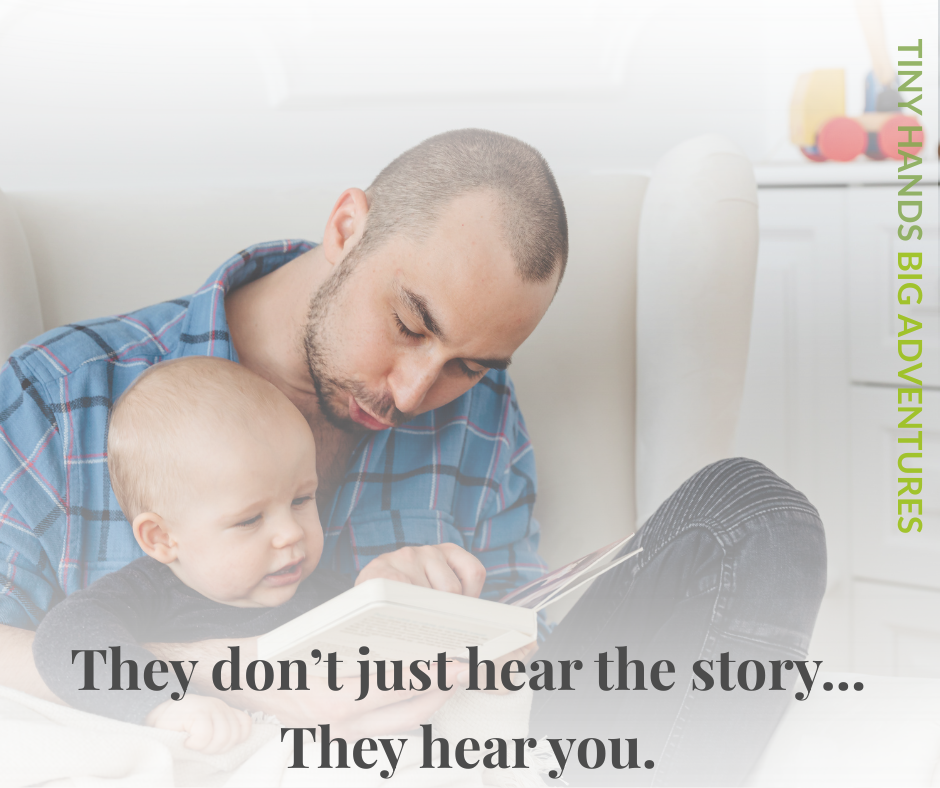
Your baby doesn’t understand the plot or the pictures. What they notice is your voice. The rhythm of it. The pauses. The way it rises and falls. They know that sound. They’ve heard it for months already, they heard it in the womb.
When you sit with a baby and read, they’re not taking in a storyline. They’re taking in you. Your breathing. Your body. The steadiness of your tone. That steadiness helps their nervous system settle. It becomes another way of saying, “You’re safe.”
At the same time, their brain is busy. Even though it doesn’t look like much is happening, neural pathways are forming rapidly in the first year of life. Hearing language strengthens the connections in the parts of the brain responsible for processing sound. The brain starts recognising patterns in speech. That’s the groundwork for understanding and eventually speaking.
It doesn’t have to be complicated or have to be every day at the same time. It just needs to happen often enough that language becomes familiar.
As babies grow into older infants, they begin to connect sounds to meaning. Long before they say their first word, they understand far more than we realise. When you read regularly, they are exposed to a wider range of words than they might hear in everyday conversation. That variety helps build receptive language, what they understand… which later supports expressive language, what they can say.
In amongst all that there’s also something else happening… Stories introduce sequence. Something happens, then something else happens. Pages turn. Familiar phrases repeat. Toddlers often ask for the same book over and over again. That repetition isn’t wasted. It helps the brain recognise patterns and anticipate what comes next. Anticipation is part of comprehension.
Books also give children a way to explore feelings safely. A character might feel cross, worried, excited or left out. Hearing those experiences in a story allows children to begin recognising emotions outside of themselves… Over time, this supports empathy. It also gives them language for their own feelings.
Sitting with a book, even for a short time, gently stretches attention. A very young child might only manage a few pages. That’s fine. Attention grows gradually. What matters is the shared focus, the experience of looking at something together and staying with it for a moment.
Reading can also become a familiar anchor in the day. Many families use it before bed, and there’s a reason for that. The predictability helps. The slowing down helps. When the a story is read in the same way, the body begins to associate it with winding down.
It’s not magic…
It’s familiarity.
As children move into toddlerhood and beyond, something shifts again. They begin to understand that the marks on the page represent sounds and ideas. That’s symbolic thinking, the ability to let one thing stand for another. It underpins reading, yes, but it also supports wider thinking skills. It allows children to imagine, to problem-solve, to hold ideas in their mind that aren’t physically present.
There is solid research behind this too. Brain imaging studies have shown that children who are read to regularly display stronger activation in areas linked to language processing, imagery and narrative understanding. Shared reading in the early years has also been associated with richer vocabulary growth and stronger comprehension skills later on. In other words, reading aloud doesn’t just pass the time… It shapes how the brain learns to process language and story.
None of this requires perfect behaviour…
Your baby might chew the corner of the book, your toddler might skip pages or interrupt constantly.
Some evenings you might not even finish the story.
But it still counts.
Reading isn’t about creating a quiet, compliant moment. It’s about sharing language and time. It’s about giving your child repeated experiences of words in the context of connection.
Over the years, those experiences add up. Not just in vocabulary or school readiness, but in how your child feels about books. If books are linked with closeness, warmth and attention, children tend to approach them differently later on.
You don’t need a huge library of books or a complicated routine and you definitely don’t need to perform the story like you are hoping for an Oscar.
You just need your voice… they just need your voice and a few minutes here and there.
If you want more ways you can connect with your little one, pop over and visit our download hub where we have some free early years resources and more being added soon.
That is more powerful than it sounds.
Further Reading
Benefits of reading – BookTrust
https://www.booktrust.org.uk/resources/reading-benefits
Reading in the early years – BookTrust & Bookstart Baby
Read It Again! Benefits of Reading to Young Children — Head Start
https://headstart.gov/publication/read-it-again-benefits-reading-young-children
Effects of Early Literacy Promotion on Child Language — PMC (NIH)
https://pmc.ncbi.nlm.nih.gov/articles/PMC10236559
Home reading environment and brain activation — PMC (NIH)
https://pmc.ncbi.nlm.nih.gov/articles/PMC9923605
Child development and reading — Reach Out and Read