
Baby brain explained: What pregnancy actually does to your brain.
By Amanda – Tiny Hands Big Adventures – April 2026
You were told six weeks...
Six weeks and then, the implication goes, you should be getting back to normal. Back to yourself. Back to feeling like you again. If you have ever searched ‘ baby brain explained ‘ during a sleepless night … this is just for you.
Because here you are, months later, and something still feels different. The fog hasn’t lifted. You cry at things that wouldn’t have touched you before. You walk into a room and forget completely why you went in. You feel things more intensely than you used to. You notice things you never noticed before.
And somewhere underneath all of it is a quiet, unsettling question… Is this just me?
It isn’t. And there’s a reason for all of it.
What you’re experiencing has a name. It’s called ‘matrescence‘. And what’s happening inside your brain right now is backed by science.
WHAT PREGNANCY DOES TO YOUR BRAIN
Most people know that pregnancy involves a big hormonal shift. But what far fewer people are told is that pregnancy also changes the physical structure of the brain itself… Not after birth. During pregnancy. Before your baby has even arrived.
Research using MRI scanning has shown that specific areas of grey matter (the tissue responsible for processing information and understanding other people) reduce in volume during pregnancy and continue changing well into the postpartum period.
These are not small or incidental changes. They are measurable, consistent, and found across multiple studies.
This isn’t emotional. It’s not psychological. It is physical. It is happening inside your brain whether anyone mentions it or not.
WHAT THE RESEARCH ACTUALLY FOUND
One study followed a mother’s brain through 26 MRI scans, from before she conceived all the way through to two years after her baby was born. The scans showed a clear and continuous pattern of change throughout the whole period. This research was published in Nature Neuroscience in 2024 and launched what is now called The Maternal Brain Project, an international effort to map the brain across pregnancy in a much larger and more diverse group of women.
A 2021 study went even further. It followed mothers from an earlier study and scanned them again six years after giving birth. Most of the brain changes were still clearly there. Researchers could tell the difference between mothers and women who had never been pregnant simply by looking at their brain scans, with over 91% accuracy. Years later. Not weeks… Years.
So the idea that a woman should feel fully recovered and back to herself within six weeks is not just unhelpful. It’s based on a fundamental misunderstanding of what her brain has actually been through.
THIS ISN’T DAMAGE. IT’S YOUR BRAIN BECOMING MORE FOCUSED.
When people hear that grey matter reduces during pregnancy it sounds big and actually quite scary. Like something has been lost… But that’s not what’s happening.
Researchers describe this process as pruning. Pruning, in the context of the brain, is not about losing capacity. It’s about becoming more precise. More efficient. More targeted…
Think about how a garden looks after it’s been properly pruned. It’s not less. It’s clearer. Stronger. and growing in the right direction.
The areas most affected are those involved in reading other people’s emotions, picking up on subtle cues, and understanding needs that are not being put into words… Which is exactly what you need when you are caring for a baby who cannot tell you what is wrong.
That feeling of knowing something is off with your baby before you can even explain how you know? That’s not instinct in some vague, mystical sense. That’s your brain, restructured and refined, doing precisely what it changed itself to do.
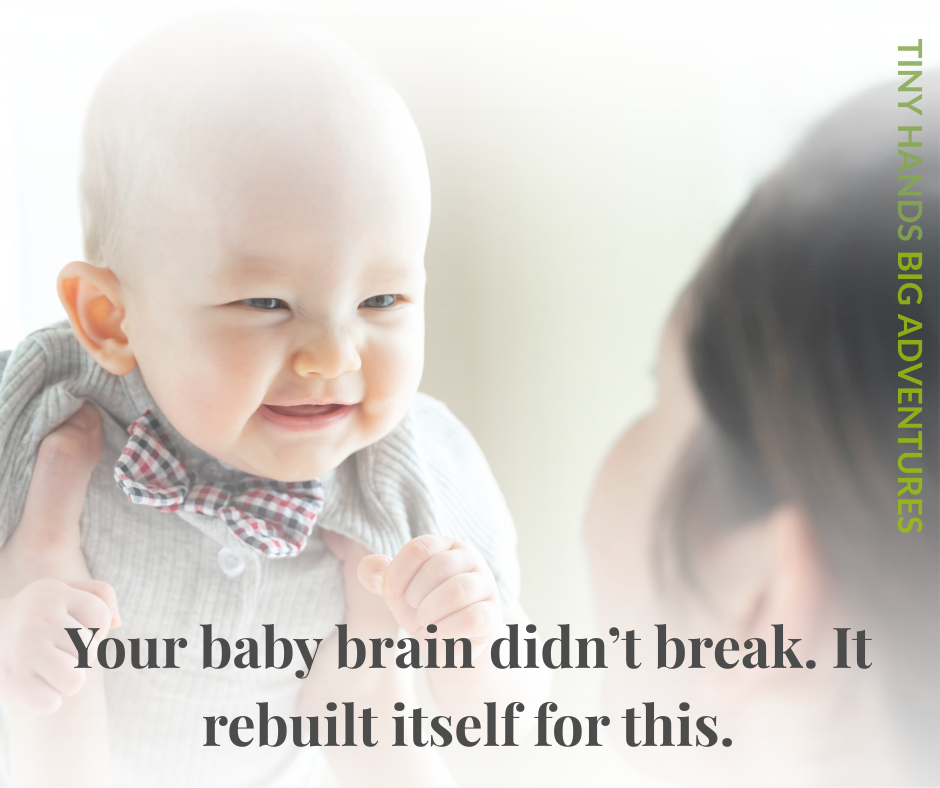
Your brain is not becoming less. It’s becoming differently capable. It’s reorganising itself for the most important job it has ever had.
THE “FOURTH TRIMESTER” IS JUST THE BEGINNING
The first three months after birth are significant. But the neurological changes of new parenthood don’t switch off at twelve weeks. Or six months… Or even a year.
For many mothers the process of adaptation continues long after the newborn stage has passed… And this is where it gets really tough. Because the visible support tends to drop away. Health visitor checks reduce. Friends and family assume things have settled… The expectation quietly shifts back toward normal.
And the mother who’s still feeling foggy, still more emotional than she used to be, still not quite herself… she starts to wonder if she’s the problem.
She is not the problem. Her brain is still doing it’s work.
Some mums find that baby massage can be a really gentle way to support both themselves and their baby during this time. The slower pace, the skin to skin contact, and the focused time together can help settle an overwhelmed nervous system… for both of you
THERE’S A WORD FOR WHAT YOU ARE GOING THROUGH…
‘Matrescence’.
It was coined by anthropologist Dana Raphael in the 1970s and describes the transition into motherhood as a genuine developmental shift. As significant as adolescence. And just as disorienting.
Think about how we talk about teenagers. We expect them to be emotional. We expect them to feel lost sometimes, to not quite know who they are, to move between the person they were and the person they are becoming. We give them time. We give them patience. We accept that this transition takes as long as it takes…
That same grace is rarely given to new mums... And yet the shift is just as real. Just as profound. In some ways more so, because it happens faster, with less sleep, and with a tiny person who is completely dependent on you at the centre of it.
The memory lapses. The heightened emotions. The sense of not quite recognising yourself in the mirror, or in your own reactions, or in the life you are now living. The strange grief for the person you were before, even when you love your baby completely and wouldn’t change it for the world. These things can exist at the same time… They often do.
These aren’t t signs that you are failing at parenting… They’re signs that you’re in the middle of something… Something significant. Something that takes time. Something that deserves to be named, not dismissed
Understanding that doesn’t make the hard days easier in a practical sense. But it can change the story you tell yourself about those days.
And that story matters more than most people realise.
ONE MORE THING WORTH SAYING
None of this is happening in easy conditions…
It’s happening alongside significant sleep deprivation. A complete shift in your daily life. A change in your relationships, your identity, and the way the world sees you. The emotional weight of keeping a small human alive, often with far less support than you expected or needed.
Your brain is going through a major structural reorganisation in the middle of one of the most demanding periods of your life…
Of course it’s hard. It was always going to be hard. That’s not a reflection of you. It’s a reflection of what this actually is.
WHEN TO TALK TO SOMEONE ABOUT POSTNATAL MENTAL HEALTH
This post is about normal neurological changes. It is not a substitute for professional support.
If you’re feeling persistently low, anxious, or struggling to get through the day, please do speak to your GP or health visitor. Perinatal mental health difficulties are common, they’re not a sign of weakness, and help is available.
You don’t have to wait until things feel unbearable.
FURTHER READING
Postnatal depression and perinatal mental health — Mind
Mental health in pregnancy — NHS
https://www.nhs.uk/pregnancy/support/mental-health-in-pregnancy
PANDAS Foundation — perinatal mental health support
https://www.pandasfoundation.org.uk
Matrescence – Becoming a mother
STUDIES REFERENCED IN THIS POST
Pritschet et al. (2024) — Neuroanatomical changes observed over the course of a human pregnancy — Nature Neuroscience
https://www.nature.com/articles/s41593-024-01741-0
Martínez-García et al. (2021) — Do Pregnancy-Induced Brain Changes Reverse? The Brain of a Mother Six Years after Parturition — Brain Sciences
https://www.ncbi.nlm.nih.gov/pmc/articles/PMC7912216
Hoekzema et al. (2017) — Pregnancy leads to long-lasting changes in human brain structure — Nature Neuroscience