
Amanda – Tiny Hands Big Adventures – June 2026
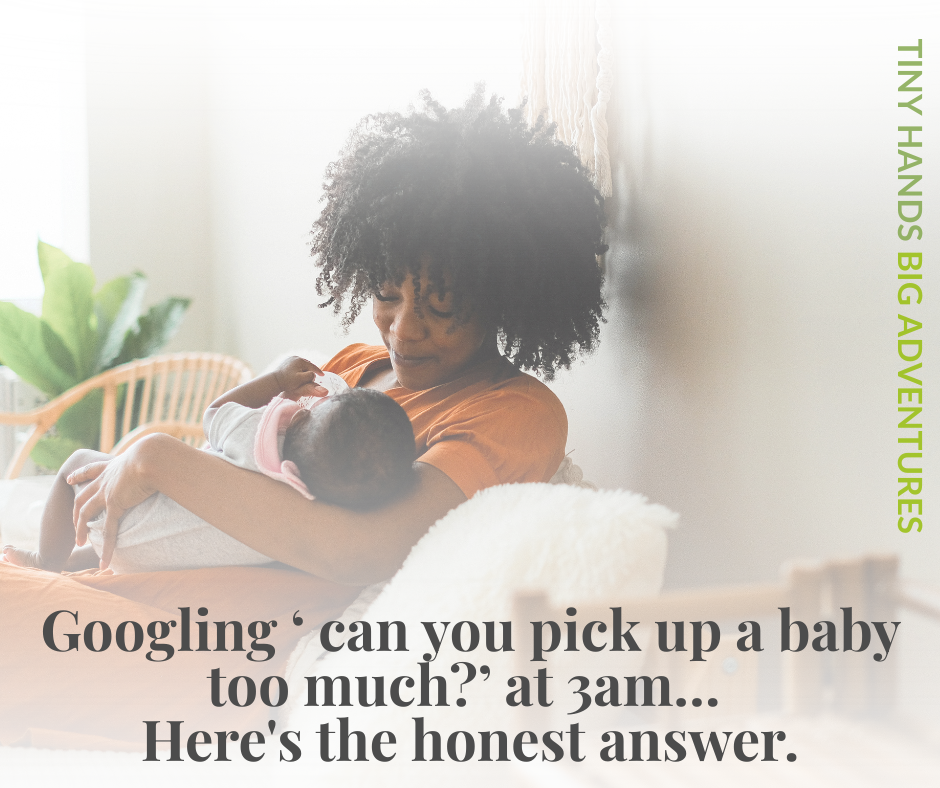
Someone has probably already said it to you. Maybe a well-meaning relative or someone in the supermarket who caught you with your baby strapped to your chest. “You’ll make a rod for your own back, you know.”… And just like that, you’re googling ‘ Can you pick up your baby too much’ at 3 am, and something that felt completely natural, picking up your baby, cuddling them, holding them close and responding when they cry… suddenly becomes something you’re questioning.
So let’s talk about it honestly. Can you pick up your baby too much? And where does this idea that babies need to learn independence actually come from?
Where did the “don’t pick them up” advice come from?
The idea that responding to a baby every time they cry will spoil them has been around for decades. It became ‘a thing’ in the 20th century, largely shaped by behaviourist thinking, who saw babies as blank slates that they believed needed to be training into good habits from day one.
The worry was simple: if you always pick them up, they’ll always want picking up. And a baby who always needs holding is… a problem, apparently!
The flaw in that though is that the logic doesn’t hold up. Not developmentally, and not biologically. Because when you understand what a baby actually is… what they’re built for, what they expect from the world when they arrive in it, the idea of “spoiling” a newborn starts to fall apart pretty quickly.
Humans are carry mammals
This often changes everything for many parents.
Scientists generally group mammals into four categories when it comes to how they care for their young:
Cache mammals (like rabbits and deer, who leave their young hidden and return to feed), nest mammals (like cats and dogs, who leave their babies and come back several times a day), follow mammals (like horses, whose young can walk within hours of birth), and carry mammals.
Humans are carry mammals. Along with apes, marsupials, and our other closest primate relatives. That’s not a parenting philosophy… it’s actual biology. Carry mammals give birth to the most immature young of any of the four groups. Human babies can’t regulate their own temperature, can’t move themselves to safety, can’t find food. The absolute reality is that they arrive in the world completely dependent. And crucially, they arrive expecting to be on a body.
Research published in Infant Behavior and Development describes this need as an evolutionary predisposition: babies are born with the expectation to be carried, and for their primary caregiver to fill that role. It isn’t a want.
It isn’t a bad habit in the making. It is what human babies are biologically wired for.
The transport response
Now this is something that might feel familiar even if you’ve never heard it given this name before.
You’re holding your baby, sitting down, and they’re unsettled. You stand up and start walking, and within moments they calm. It’s almost instant.
Scientists call this the transport response, or carrying-induced calming. When a parent or caregiver walks while holding a baby, the babies heart rate slows, their muscles relax, and crying decreases. Scientists have documented this response across multiple species of mammals… it isn’t random, and it isn’t something babies do to get attention. It’s a deep embedded physiological response that’s hardwired in to us.
It’s the same response that has kept human babies safe for hundreds of thousands of years. When a baby is on a body, they are warm, fed, close to the heartbeat they know, and protected. When they’re not.. from an evolutionary standpoint. They are vulnerable.
This is also why practices like baby massage, which centre on intentional, responsive touch, can be such a supportive part of those early weeks and months.
What happens when babies are left to cry
This is an area where the research really matters, so it’s worth us understanding what’s actually going on.
When a baby cries and isn’t responded to, their body produces cortisol… a stress hormone. Short, occasional stress responses are of course a normal part of development. But prolonged or repeated stress responses in early life, when the nervous system is still forming, can have a real and negative impact on a babies developing nervous system.
Responsive parenting… picking up your baby, holding them, cuddling them soothing them and loving them, helps regulate that stress response. Studies have shown that babies who receive consistent, responsive physical contact produce less cortisol in stressful situations. The body learns, over time, that the world is a safe place. That when something feels wrong, help comes. So actually, that’s not spoiling. That’s the foundation of secure attachment. And secure attachment in infancy is one of the strongest predictors of emotional resilience, confidence, and independence later in childhood.
The irony of this is worth remembering. The very thing parents are told will make a baby clingy, needy and dependent is, according to the evidence, what builds their capacity to eventually be independent and resilient.
So can you pick up your baby too much?
The short answer is no.
Newborns and young babies don’t have the cognitive development to manipulate you. They aren’t crying to ‘train’ you. They aren’t building habits just to inconvenience you. They are communicating the only way they know how to, and contact is what they are genuinely and biologically built to need.
Developmental experts including Mary Ainsworth, whose attachment research has shaped decades of early childhood understanding, consistently found that responsive caregiving… picking up a baby when they cry, responding sensitively to their cues, builds the bonds of attachment. These are the same behaviours that people often talk about as spoiling.
But the research tells a very different story.
And what about independence?
Independence will come, and it will come on its own timeline.
A baby who is held, responded to, and made to feel safe doesn’t become a child who can’t function without you. Quite the opposite in fact. The security built in those early months becomes the base from which a child eventually explores… confidently, because they know they have a safe place to come back to.
Early separation doesn’t ‘train’ real independence in to babies. It grows, naturally, from that foundation of feeling safe and connected.
You don’t need to justify holding your baby to ANYONE.
If someone tells you you’re making a rod for your own back, remember you absolutely don’t owe them an explanation. But if it helps to have one in your back pocket, theres this:
Your baby has a biological need for this, and you are meeting their need. It’s not spoiling them, it’s not indulging them. It’s responsive, evidence-informed parenting.
Pick them up. Hold them close. Embrace those contact naps. Walk around the kitchen for the hundredth time if that’s what helps.
You’re not creating a problem. You’re building confidence, security and safety.
Further Reading
NHS Best Start in Life. Building a close relationship with your baby
NHS guidance on responding to your baby’s cues, the importance of cuddles and close contact, and how this shapes healthy brain development.
Esposito, G. et al. (2013). Infant calming responses during maternal carrying in humans and mice.
Current Biology. The study behind the transport response — why babies calm almost instantly when picked up by a walking caregiver, and why this response is shared across mammalian species.
Hunziker, U.A. & Barr, R.G. (1986). Increased carrying reduces infant crying: A randomised controlled trial.
A randomised controlled trial showing that babies who were carried more cried significantly less… including during the peak crying weeks.
Anisfeld, E. et al. (1990). Does infant carrying promote attachment? An experimental study of the effects of increased physical contact on the development of attachment.
Research exploring the link between physical contact in early infancy and the development of secure attachment between baby and caregiver.
Psychology Today: No, You Cannot Spoil a Baby
A clear, accessible overview of the research on responsive caregiving and why the idea of spoiling a newborn doesn’t hold up developmentally.