
By Amanda – Tiny Hands Big Adventures
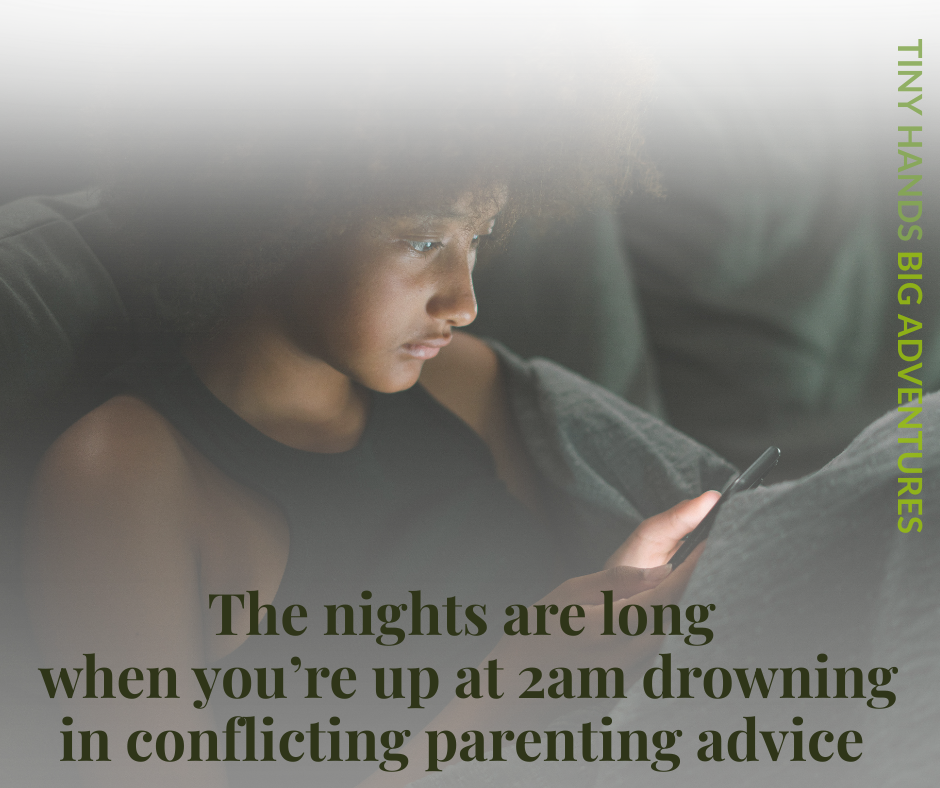
It’s 2am and you’re awake again. Maybe you’ve just got them back to sleep. Maybe you’ve given up and you’re sitting on the sofa. Either way, your eyes are burning, your phone is in your hand, and you’re typing something into Google.
Maybe it’s a sleep question. It could be a behaviour thing or maybe it’s just ‘is this normal, please tell me this is normal’. And then you fall down the rabbit hole.
One website tells you to do this. The next one tells you the opposite. A reel pops up telling you that what you just read is actually harmful. A grandparent in the comments says we never did any of this and you all turned out fine. Someone else says if you don’t follow this exact method by six months you’ll regret it.
And you sit there, more confused than when you started, feeling worse about yourself than you did ten minutes ago.
If that sounds familiar, you’re really not on your own. Conflicting parenting advice is one of the most exhausting parts of raising small humans. And it doesn’t stop when they leave the baby stage. The questions just change shape.
Why parenting advice feels so overwhelming right now
There’s never been more information available to parents. It’s literally in the palm of our hands… And that’s not always a good thing.
A generation ago you’d have had your mum, your health visitor, maybe one or two books, and the women at the village playgroup. The advice might have been outdated, or the company might have been a bit limited, but the volume of voices was small. You weren’t being shouted at by fifteen experts before breakfast…
Now you’ve got Instagram. TikTok. Mumsnet. Sleep consultants. Feeding consultants. Discipline experts. Gentle parenting accounts. Traditional parenting accounts. Books with completely opposing methods, all written by people with letters after their names. And every single one of them sounds confident…
The algorithm doesn’t help either. The more you search for solutions to one problem, the more your feed fills up with that problem. Suddenly every reel you see is about colic, or sleep regressions, or threenager meltdowns. It starts to feel like your child is the only one struggling. They’re not. The algorithm just decided what to show you.
Why the experts contradict each other
Here’s something that might help… The experts contradict each other because parenting isn’t one thing. It’s not a maths problem with a single right answer. Different advice comes from different places. Some of it is based on recent research. It may be based on much older research that’s since been challenged. Some of it is cultural, passed down from one generation to the next without anyone really questioning where it came from. Some of it is based on what worked for one expert’s own children, which might not have anything to do with yours.
And babies, toddlers, and small children are wildly different from each other. What soothes one baby will overstimulate another. What works for a calm, easy-going three year old won’t touch the sides with a sensitive, big-feeling three year old. The advice isn’t always wrong. It might just not be right for your child.
There’s also this. A lot of parenting advice is sold to you. Books, courses, programmes, memberships. The people writing it have an interest in sounding certain, because certainty sells. But real life with small children is rarely certain. It’s messy and contradictory and changes from week to week.
Why what worked for your friend probably won’t work for you
Your friend’s baby slept through at eight weeks because she did ‘the’ routine. Your sister’s toddler stopped tantrumming because she used ‘the’ chart. The mum at the school gates says her four year old eats everything because she just kept offering… And you’re sitting there thinking, I tried all of that and none of it worked, so what am I missing?.
The answer is nothing… What’s actually missing from those stories is everything else. The temperament of that baby. The sleep environment. The feeding situation. The other parent. The siblings. The genetics. The hundred tiny variables that made the routine, or the chart, or the patient offering work for that family in that moment… Other people’s wins are useful as ideas, sometimes but they’re not useful as ‘must do this instructions.’
A gentle way to filter parenting advice
So what do you actually do with all of this. You can’t just stop reading, stop scrolling, stop asking. The questions are real and you need help finding answers… Here’s a softer way to filter what you take in, instead of just absorbing all of it.
When you come across a piece of advice, ask yourself three quiet questions.
1. Does this fit my child? Not children in general. Not the children in the example. My actual child… the one I know better than anyone. If the advice assumes a baby who self-soothes easily and yours doesn’t, that advice probably isn’t for you. If it assumes a toddler who responds well to firm boundaries and yours melts down, same thing.
2. Does this fit my values? Some advice will feel wrong in your gut, even if it’s coming from someone with five degrees and a bestselling book. That gut feeling is information. It usually means the advice clashes with something you care about, like connection, or independence, or kindness, or calm. You don’t have to take advice that doesn’t fit who you want to be as a parent.
3. Does this feel doable? The best advice in the world is useless if it requires energy you don’t have, money you can’t spend, or a partner who isn’t available. Real advice has to work in your real life, not in some idealised version of it.
If a piece of advice passes those three questions, it might be worth trying. If it doesn’t, you can let it go without guilt.
Trusting yourself as the expert on your own child
This is the bit that took me the longest to learn. Nobody knows your child like you do… and for a long time, even with my childcare and child development experience, I didn’t remember this or actually trust my own internal voice.
But… YOU are the one who knows what their cry means at 3am… what their face does just before they’re about to lose it…
You’re the person know which bit of the bedtime routine they actually need and which bit you’ve all been doing for so long that nobody can remember why… and YOU know whether they’re hungry, tired or overstimulated, even when you can’t explain how you know.
That knowledge counts. It counts more than any expert who has never met your child. It counts more than any book or reel or article… That doesn’t mean you don’t need support. We all need support. But the support that helps the most is the kind that adds to what you already know about your child, rather than telling you what to do instead of trusting yourself.
If the noise is getting too loud
If you’re reading this and recognising yourself, please be kind to yourself first… Information overwhelm is real. It’s not a sign that you’re a bad parent or a weak one. It’s a sign that you care, and that there’s too much noise for any one person to hold.
Sometimes the most useful thing isn’t more information. It’s a quieter space, with people who get it, where you can think your own thoughts again. That might be a friend who doesn’t tell you what to do. A walk without your phone. A class where nobody is forcing advice or conversation with someone who knows a bit about child development but trusts you to know your child.
That’s a big part of why I do what I do… Not because I have all the answers. I don’t, and I will never promise I do… I offer ideas, routines, hints and tips… but children aren’t one size fits all and I know that. But its because I think most parents are already doing a much better job than they realise, and they just need somewhere calm to land while they figure out the rest.
That’s a big part of why I do what I do… Not because I have all the answers. I don’t, and I will never promise I do… I offer ideas, routines, hints and tips… but children aren’t one size fits all and I know that. But its because I think most parents are already doing a much better job than they realise, and they just need somewhere calm to land while they figure out the rest…
So if you’re up at 2am tonight with a phone in your hand, I hope this helps a little. Close the tabs. Put the phone down. Have a look at the small person who’s keeping you up. They’re not a problem to be solved. They’re just yours, and you already know them better than the internet ever will.
Further Reading
If you do want to read more, here are a few sources worth bookmarking. They’re calm, evidence-informed, and not trying to sell you anything.
NHS Best Start in Life — the NHS hub for trusted advice from pregnancy through the early years, all in one place.
Family Lives — a UK charity offering free parenting support, articles, and a confidential helpline for parents of children of any age.
Information Overload for Parents — a clear write-up of the research showing how endless searching can quietly knock your confidence, and what to do about it.